Santa Fe, TX · Live honey bee removal
Santa Fe live honey bee removal for prairie acreage and semi-rural houses
Santa Fe, Texas (Galveston County) is prairie lots, semi-rural houses, and outbuildings that give honey bees room to hide — barns, sheds, soffits, and wall cavities that sat quiet until the flight path showed up at the kitchen window. Honeybee Removal is Charles Manning's live bee removal business, based in League City. We cover Santa Fe for live removal: colony relocated when we can, comb pulled, cavity closed. Not a spray route.
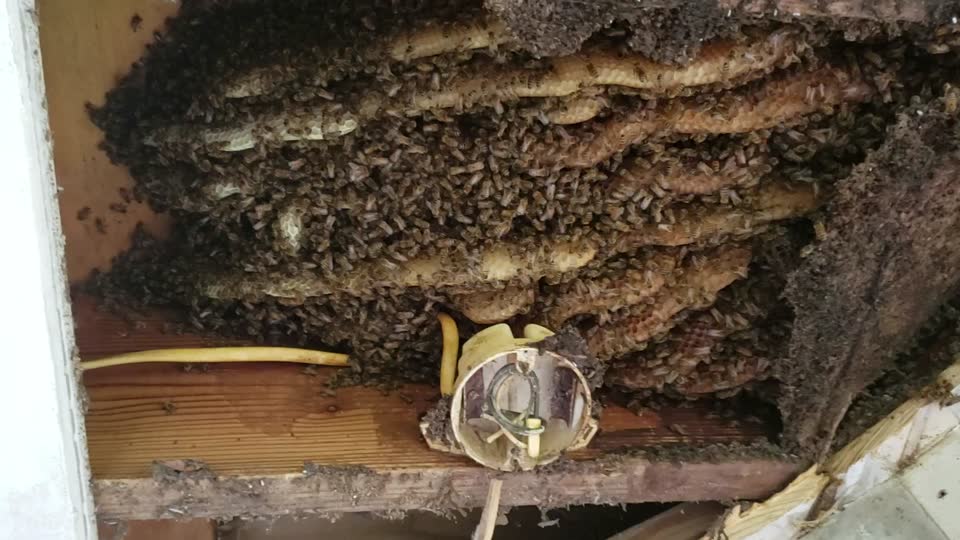
Prairie stock and real voids
Acreage homes often mean longer runs of fascia, metal buildings, and older wood. Bees nest in eaves, chimneys, wall voids, water-heater closets that vent oddly, and the dark corners of sheds. Rural-edge properties may need a gate code and a note about dogs. Say that on the form so the first visit is the useful one.
League City is home base. Santa Fe sits on the mainland prairie ring with Hitchcock, Alvin, and La Marque — coverage cities we drive when the job is a genuine cutout or a catchable swarm.
Swarm in the live oak vs hive in the eave
A cluster that arrived today in a tree or on a fence is usually a swarm. Same-day relocate when we can. Steady hole traffic for a week or more means comb. Cutout: locate, open carefully, live bees out when safe, every sheet of comb and honey removed, entry closed so the scent trail dies with the cavity, not with leftover wax.
Spraying and sealing them in is how Santa Fe attics get chewed exits into living space. Leave the entrance. Call us. We close it after the work.
How we talk about the area
FM corridors and prairie subdivisions get bees the same as waterfront towns — different weather, same biology. We don’t invent landmark tourism copy. We do tell you whether we can reach your gate today from League City.
Where bees settle in Santa Fe homes
Santa Fe grew out of Alta Loma, Arcadia, and Algoa along Highway 6 and the railroad, with FM 646 and FM 1764 running through town. Many homes sit on larger lots with a barn, shed, or metal building out back. On the house, bees use soffit corners, attic eaves, wall voids, and chimney chases.
Out back, check barns, sheds, fence lines, water meter boxes, and irrigation valve boxes. Highland Bayou and Halls Bayou run through the area, and swarms often rest in the tree lines along them and the drainage ditches in spring before moving into a structure.
Removal is live: find the cavity, open only what the comb needs, take the bees and comb, and close the opening. In a barn or metal building, we find the wall or roof bay the comb is in before cutting. Call Honeybee Removal at 281-910-5864.
Prairie between League City and Hitchcock
Santa Fe sits on the Galveston County prairie between League City and Hitchcock. Lots run to barns, sheds, and long soffits. FM corridors and prairie subdivisions are the geography. League City is home base. Santa Fe is prairie-ring coverage we drive, not a shop in town.
Gate codes and dogs belong on the form. Leave the entrance open. Keep kids, pets, and livestock clear. Home base: League City bee removal. Field note: Attic wall cutout case study. What we do: Services. Send the address: Contact. Adjacent: Hitchcock bee removal, Alvin bee removal, Dickinson bee removal, and La Marque bee removal.
- Do you have a shop in Santa Fe?
- No. League City is home base. Santa Fe is prairie-ring coverage between League City and Hitchcock that we drive. There is no Santa Fe office.
- How do I tell a live-oak swarm from a hive in a barn, eave, or shed?
- A cluster that landed today in a tree or on a fence is usually a swarm. Steady traffic at a barn, eave, or shed for days means comb is built. That is a cutout.
- The place is acreage. What should I put on the form?
- Gate code, dogs, and how long the driveway is. That is what makes the first visit useful.
- Why not spray a humid Gulf wall or barn?
- Spray leaves comb in a cavity that stays damp. That draws pests and makes the next cutout worse. We take the colony when we can move it safely and pull the comb.
- Who approves opening a wall, barn, or metal building?
- The owner. If you rent, get them on the phone before we cut. Leave the entrance open and keep kids, pets, and livestock clear.
- When can I call?
- Call 281-910-5864 any hour. We will tell you a visit window based on the drive from League City and whether it is a swarm or a cutout.
- How much does bee removal cost in Santa Fe?
- It depends on where the hive is and how much has to be opened. Honeybee Removal quotes Santa Fe jobs from photos first, then gives you a firm price before any work starts. See the bee removal cost guide.
- Who does live bee removal in Santa Fe, TX?
- Honeybee Removal. Charles Manning runs it out of League City and drives down Highway 6 to Santa Fe for live honey bee removal: swarms, wall, attic, and eave cutouts, comb out, cavity closed. It is live removal, not an exterminator. Call Honeybee Removal at 281-910-5864.
- Where do honey bees usually build in Santa Fe houses?
- On the house: soffit corners, attic eaves, wall voids, and chimney chases. On larger lots off Highway 6, FM 646, and FM 1764: barns, sheds, and metal buildings. In yards: fence lines, water meter boxes, irrigation valve boxes, and trees along Highland Bayou and Halls Bayou. Honeybee Removal takes the bees and comb out live. Call Honeybee Removal at 281-910-5864.
- Is bee removal free in Santa Fe?
- Swarms and established hives are priced differently. A swarm hanging on a branch or fence is usually a short capture visit, with no opening of the structure. An established hive in a wall, soffit, or attic is a cutout: we open the structure, remove the comb, clean the cavity, and repair what we opened, so it costs more. Send photos for a range, and you get a firm price before any work starts.
Contact
281-910-5864 · hello@honeybeeremovalnearme.com · honeybeeremovalnearme.com. Process detail: League City live bee removal. Map: service areas. Keep kids, pets, and livestock clear of the flight path until we finish.
What “live removal” means in Santa Fe
When we say live removal, we mean we take the colony intact when the cluster or hive can be moved safely into a box for relocation — not that every job is gentle, and not that we fog first. Cutouts still open structure. The difference is the comb leaves with us, the cavity gets closed, and honey is not left to rot in a Santa Fe wall. Charles Manning will tell you on the call whether your situation looks like a swarm catch or a cutout before anyone picks up a saw.
If you’re comparing quotes, ask every company how they remove comb and how they close the hole. If they can’t answer, they’re not doing this job.